What is NMES, and what can it help me do once the electrodes are off?
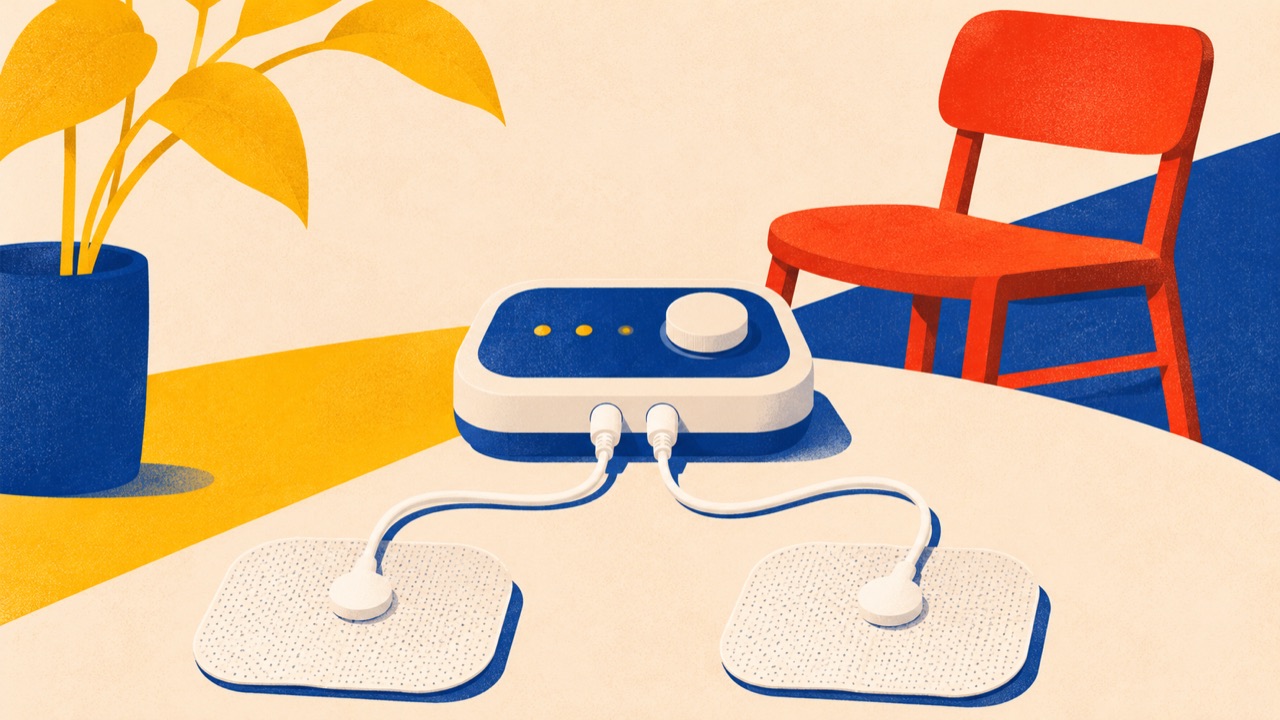

After knee surgery, you sit on the edge of the bed and try to straighten your leg. You are making a real effort, but the front of your thigh barely responds. A physiotherapist applies electrodes and the muscle contracts. Your question may be more practical: “Will it be easier to get out of a chair or manage the steps into my home when the machine is off?”
For some people recovering from knee surgery, neuromuscular electrical stimulation (NMES) can support strength recovery while it is difficult to produce a strong contraction voluntarily. After total knee replacement, researchers have measured benefits not only on strength tests but also on tasks involving standing up, walking and using stairs. That does not mean someone with everyday knee pain should expect the same benefit from the same device. Randomised trial after total knee replacement
Why consider stimulation if I’m already trying hard?
Early after surgery, difficulty producing force is not always a matter of doing too little exercise. Even with genuine effort, you may struggle to fully activate the quadriceps at the front of your thigh. NMES sends electrical pulses through skin electrodes to stimulate the motor nerves supplying the muscle. This offers another way to produce a contraction while voluntary activation is limited. Its purpose differs from TENS, which is mainly used for temporary pain relief. With NMES, the immediate question is whether the target muscle can contract effectively—not simply whether the knee hurts less. Postoperative muscle activation and NMES; NHS: What TENS is used for
When have patients experienced a measurable benefit?
After total knee replacement: less early loss of strength and mobility. A randomised trial followed 66 adults having a first total knee replacement on one side. Both groups received standard rehabilitation; one also received early quadriceps NMES. About three and a half weeks after surgery, the NMES group had lost less strength relative to their preoperative level and showed better active knee extension than the comparison group. The researchers also tested tasks patients would recognise: getting up from a chair, walking a short distance, turning and sitting back down; going up and down stairs against the clock; and walking for six minutes. The NMES group performed better on these tasks. “Better” here largely means a smaller early decline—not a promise of being back to preoperative mobility within three weeks. Total treatment time was not matched, so the trial supports NMES as an addition to rehabilitation without establishing that the electrical current alone accounted for every difference. Stevens-Lapsley et al.: trial and functional test results
After anterior cruciate ligament (ACL) surgery: the evidence is more consistent for thigh strength than for overall knee recovery. Reviews of randomised trials found better quadriceps strength recovery when NMES was added to rehabilitation than with rehabilitation alone. Findings for patient-reported knee function were less consistent across reviews. If the immediate problem is “I can’t get much force out of my thigh,” that evidence is relevant. If the question is “Can I get back on the pitch sooner?”, a strength gain alone cannot provide clearance. A strength test does not establish that a graft has healed or that you are ready to cut, stop suddenly or return to competition. 2025 systematic review; subsequent meta-analysis of randomised trials
Knee osteoarthritis without surgery: a different clinical question. The UK NICE guideline advises against offering NMES to manage osteoarthritis because evidence of benefit is insufficient. This does not contradict the knee replacement trial. Treating osteoarthritis itself is different from trying to limit early postoperative losses when a muscle is difficult to activate. Even for the same person, the reason to consider a device may change after surgery. NICE osteoarthritis guideline, recommendation 1.3.9
How will I know it is helping, rather than just making the muscle twitch?
Agree on one movement to retest with the electrodes off. If straightening the knee is your immediate difficulty, compare how far you can straighten it yourself in the same position. If the goal is to get up from your dining chair, compare the same chair and the same use of armrests when that task is appropriate for your stage of recovery. The first observation tells you about active movement; the second tells you whether a change is carrying over into daily life. If strength improves but getting up is still difficult, the strength gain is not wasted. It tells you that standing up still deserves practice in its own right.
If home use is proposed, ask a qualified professional to check suitability, demonstrate the equipment and watch you use it. Three questions are more useful than chasing a higher setting: “Which difficulty are we targeting? When will we retest it without stimulation? What will we change if the muscle contracts during treatment but the task is no easier afterwards?”
This guide is for general education. It does not replace an individual assessment or postoperative instructions.
For education only. Not a substitute for individual assessment or medical advice.