What is shockwave therapy? Can it ease pain, improve activity or help tissue heal?
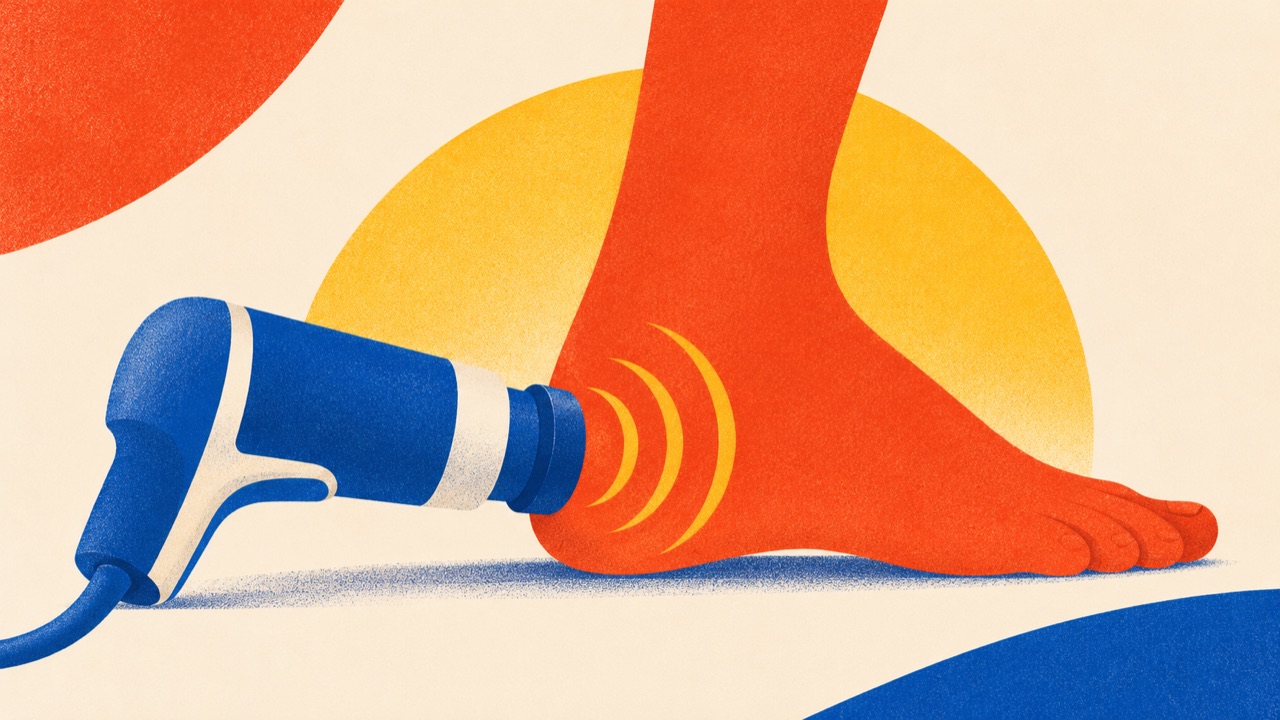

Your heel hurts as soon as it touches the floor in the morning. You hold on to the bed for the first few steps until it settles. If this has been happening for months and someone suggests shockwave therapy, your first question is probably a practical one: “Could it make getting out of bed and walking during the day less painful?”
For some people whose persistent heel pain has been assessed as plantar fascia-related, pain relief is a potential benefit supported by clinical research. Walking farther, returning to running and healing tissue faster are separate outcomes. A pain score alone cannot establish all three. Randomised trial of focused shockwave therapy for chronic plantar fasciitis
What does the treatment do?
An applicator placed against the skin delivers a series of brief mechanical pressure pulses towards a target area. This is neither electrical stimulation nor laser treatment. Two technologies are commonly described as “shockwave”: focused shockwaves concentrate energy in a target region, while radial pressure waves spread out from near the applicator. Their pressure fields differ. A shared name does not make their effects interchangeable, and a more concentrated field is not automatically a better treatment. International Society for Medical Shockwave Treatment: technical statement
Researchers are interested in whether mechanical stimulation can alter local pain signalling and whether cells respond in ways relevant to repair. Cells can respond to physical forces as well as chemical signals. But a cellular response is not proof that an injured human fascia or tendon heals sooner. Nor is “breaking up damaged tissue so it grows back” a sound general explanation for treating plantar heel pain. ISMST: mechanisms and uncertainties
What benefits have patients actually experienced?
A multicentre randomised trial in chronic plantar fasciitis looked beyond how the heel felt immediately after treatment. Its combined pain measure included pain on the first steps in the morning, pain during daily activities and pain when pressure was applied during examination. Twelve weeks after treatment ended, the combined pain score had fallen by 69.2% in the focused shockwave group versus 34.5% in the sham group. These are reductions in a score, not percentages of patients cured. What makes the result useful is that it included pain people encountered in daily life, not just tenderness on the treatment table. Gollwitzer et al., multicentre randomised trial, 2015
Another trial asked a different question: if people with plantar fasciopathy already receive advice and customised foot orthoses, does adding radial pressure-wave treatment give them further relief? It found no additional benefit for heel pain over advice and orthoses alone. The two studies used different technologies and comparison treatments; they were not a head-to-head test of focused versus radial therapy. Read together, they support a practical conclusion: shockwave may reduce pain in some circumstances, but adding a device to an existing care plan does not necessarily improve the outcome. Randomised trial of radial treatment for plantar fasciopathy, BJSM, 2024
How do you distinguish pain relief, recovery of activity and healing?
Less pain on your first morning step is a worthwhile symptom change. Reaching the station without your usual stop, with a manageable response the next day, is a meaningful gain in activity. Record both if they matter to you. Neither establishes that the fascia has fully repaired or that a tendon is ready for running and jumping.
Evidence for plantar heel pain should not be transferred to the Achilles tendon simply because the two sites are close together. A 2026 systematic review in adults with Achilles tendinopathy did not find clear, clinically meaningful benefit sufficient to support routine shockwave treatment. Confidence in many estimates was low. Pain beneath the heel and pain at the back of the heel may sound similar, but the treatment evidence is not the same. Achilles tendinopathy systematic review and meta-analysis, JOSPT, 2026
Before choosing treatment, ask: “What do we hope it will change for me? What are the alternatives? What will we check before deciding whether to continue?” For one person the goal may be taking those first steps without holding on to the bed. For another, it may be walking to work again. Either is a better starting point than a generic claim about success rates.
For education only. Not a substitute for individual assessment or medical advice.