Which changes are worth tracking over time?

Start by asking what has become easier, then look at how much the numbers changed. A meaningful change should tell you whether you are closer to a goal in daily life. One day with less pain, a faster walk or a higher score does not tell the whole story.
What does this look like in daily life?
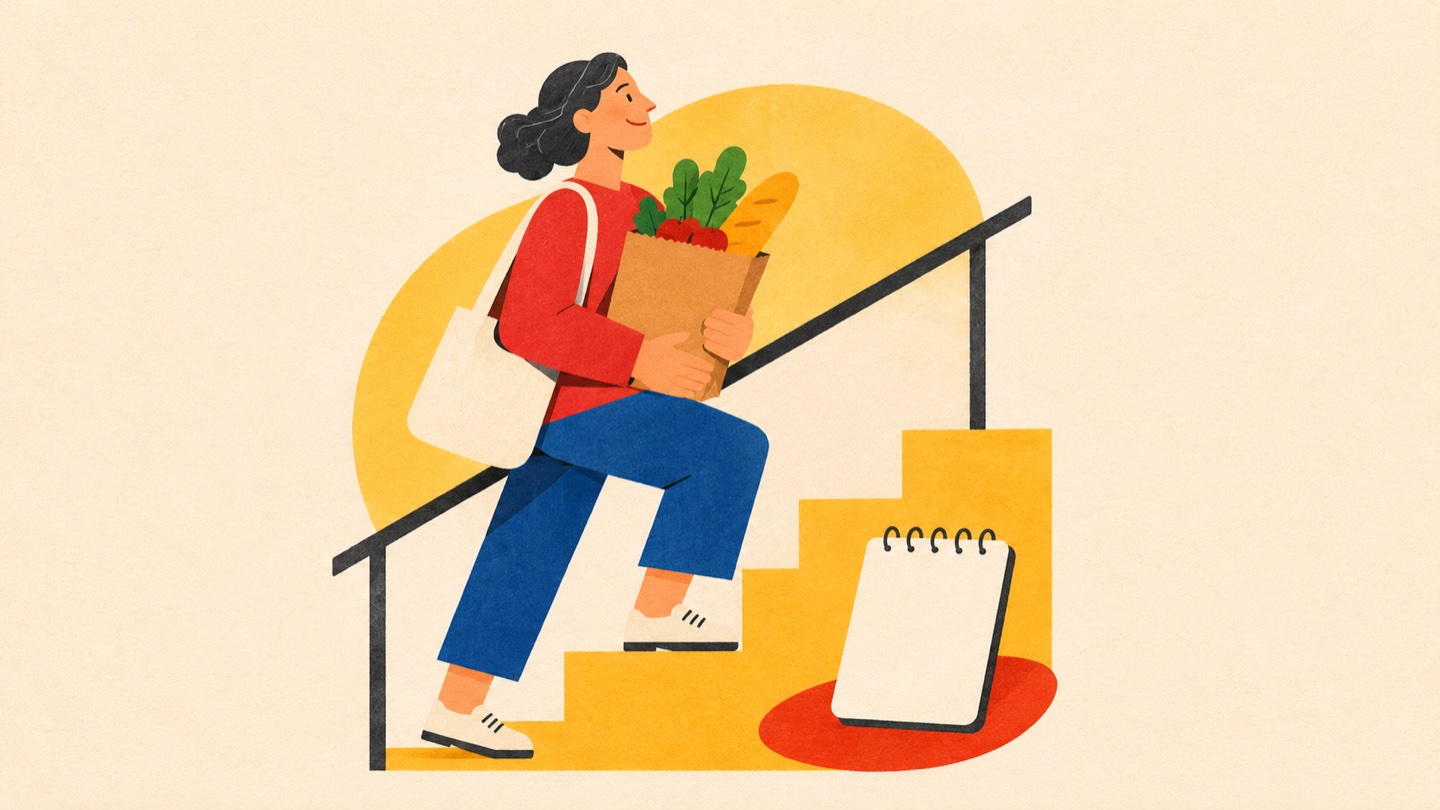
Pick one or two tasks that matter to you. Perhaps you used to carry groceries upstairs in two trips. Now you manage the same stairs in one trip without an extra stop and can carry on with your day as planned. Note what you did, what help you used, how hard it felt and what you could do afterward. If the route, weight or kind of help changes, write that down rather than treating two unlike measurements as proof of progress.
What matters at different ages?
A teenager might notice whether they can take part in school activities after training. A young adult might track whether they can keep up the exercise they enjoy during the workweek. Someone in midlife might notice whether carrying things or using stairs feels easier. An older adult might focus on going out or running errands on their own terms. If the goal changes, change what you track rather than keeping a test that no longer helps.
When is further assessment useful?
One good or bad result is not enough to draw a conclusion. If a familiar task keeps getting harder in much the same conditions, or you develop significant new symptoms, seek appropriate assessment rather than relying on a log alone.
This article is for health education and does not replace individual assessment, diagnosis or treatment advice.
Reference: Pathak A, Wilson R, Sharma S, et al. (2022). Measurement properties of the Patient-Specific Functional Scale: systematic review. DOI: 10.2519/jospt.2022.10727; PMID: 35128944.
For health education only. This does not replace individual assessment, diagnosis or treatment.
Everyday examples
If your goal is opening a jar, note whether it was the same type of lid, whether someone loosened it first, and whether your elbow hurt more afterwards. You need not choose a tighter lid every day to prove progress.